
Top 10 SSO Providers in 2026: A Comprehensive Overview
Discover the top 10 SSO providers in 2026 for secure, convenient, and scalable single sign-on solutions. Learn what features set the best SSO providers apart.
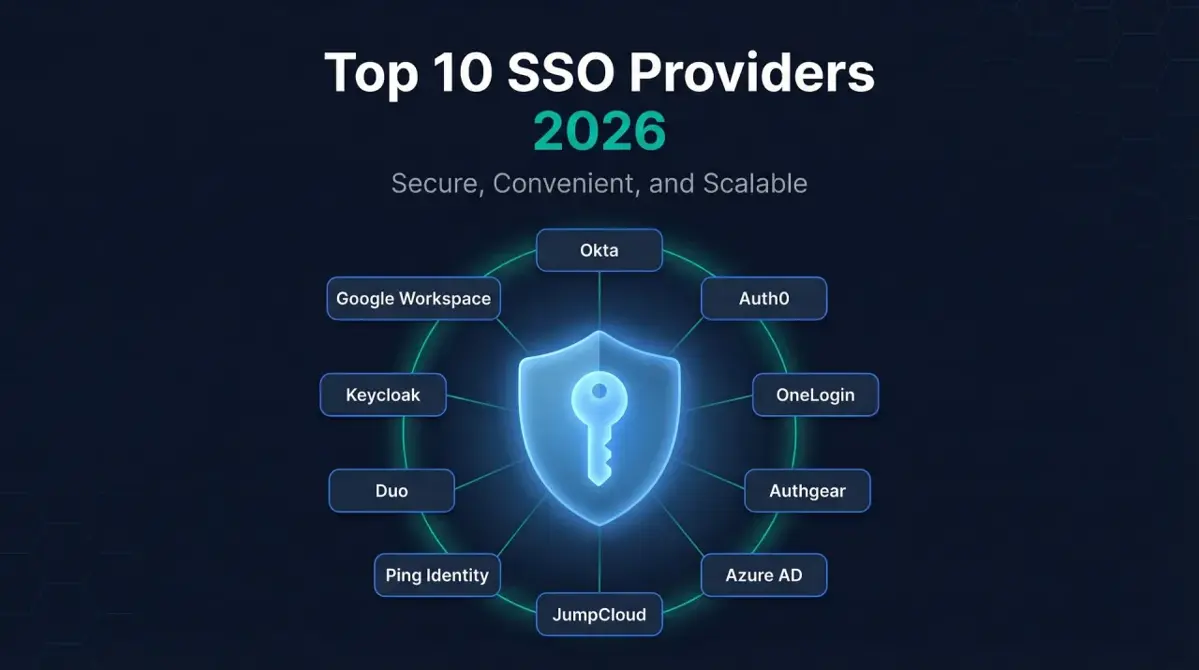
tl;dr: Pick Okta or Ping Identity for large enterprises with strict compliance needs, Auth0 or Authgear if you’re adding SSO to your own product, OneLogin for straightforward workforce SSO, and Microsoft Entra ID (formerly Azure AD) or Amazon Cognito if you’re already committed to Microsoft or AWS.
Top 5 SSO Providers in 2026 (Comparison Table)
A quick comparison of the top five, then providers 6–10 below.
| SSO Provider | Key Features | Pricing Model | Integration Complexity | Notable Clients |
|---|---|---|---|---|
| Okta | - Enterprise-grade security - MFA options - User-friendly admin console |
Subscription tiers based on features and user count | Medium (good docs, but advanced setup) | Major corporations in finance, healthcare |
| Auth0 | - Highly customizable - Excellent developer experience - Social logins support |
Freemium & paid tiers | Low (extensive SDKs & docs) | Tech startups & SMEs |
| Ping Identity | - Advanced IAM tools - Adaptive authentication - Strong compliance coverage |
Tiered pricing for enterprise solutions | Medium (focus on enterprise needs) | Fortune 500 enterprises |
| OneLogin | - Cloud-based directory integration - Smart MFA & risk-based auth - Policy-driven security |
Subscription per user/month | Low (straightforward UI, guides) | Retail & e-commerce brands |
| Authgear | - Seamless developer integration - Modern open standards (OAuth 2.0, OIDC) - Customizable user experience |
Custom pricing & usage-based tiers | Low (intuitive developer tools) | Growing SaaS businesses & modern enterprises |
Adding SSO to your own product? Authgear gives you OIDC and SAML SSO, MFA, and brandable login pages on a free tier, without enterprise sales calls. Create a free account and have SSO running the same afternoon.
If you’re planning a rollout, our Comprehensive Guide to Single Sign-On Implementations covers the implementation side.
What Is an SSO Provider?
An SSO provider is also called an SSO identity provider (IdP): the system that checks who a user is and tells your apps, over OIDC or SAML, that they are signed in.
It simplifies authentication for both users and administrators. Acting as a centralized identity system, an SSO provider verifies who users are and manages their access to multiple applications or websites through a single set of login credentials. Instead of requiring separate logins for different applications, a user only needs to authenticate once with the SSO provider, and they can then gain secure access to any connected service.
Key Benefits of Using SSO Providers
- Convenience: Users spend less time logging in, improving productivity and user satisfaction.
- Security: Centralized identity management helps maintain stronger security policies (e.g., multi-factor authentication, password complexity requirements).
- Scalability: Easy to integrate new apps and services for users, making it a scalable solution for growing organizations.
- Cost Savings: Reduced password reset requests and simpler IT administration.
Features of a Good SSO Provider
Not all SSO providers are created equal. Here are the features you should look for when choosing an SSO solution:
- Robust Security Protocols Look for support of modern security standards such as OAuth 2.0, OpenID Connect, and SAML. Advanced threat detection, risk-based authentication, and multi-factor authentication (MFA) are also essential.
- Easy Integration & Developer-Friendliness A good SSO provider will offer comprehensive APIs, SDKs, and documentation. This reduces development overhead and speeds up integration across a range of platforms and applications.
- Flexible Customization Being able to adapt the SSO solution to your branding and workflow is crucial. Features like customizable login pages, user consent pages, and the ability to enforce specific security policies can be game-changers.
- Scalability & High Availability Ensure the SSO solution can handle rapid user growth and high-traffic scenarios without performance bottlenecks. Uptime guarantees and redundancy are also critical for reliability.
- Reporting & Analytics Detailed logs and analytics allow IT teams to monitor user behavior, track sign-in patterns, and address suspicious activities quickly.
- Customer Support & Community The best SSO providers offer a strong support system, including knowledge bases, user communities, and responsive technical support channels.
6. JumpCloud
JumpCloud is another cloud-based directory and SSO solution that caters to small and medium-sized businesses looking to unify user directories, device management, and application access. They place emphasis on cross-platform compatibility and zero-trust security models, making them a robust option for diverse tech stacks.
7. Microsoft Azure Active Directory
Azure Active Directory (Azure AD) is part of Microsoft’s ecosystem, offering SSO for both Microsoft services and third-party applications. While it integrates seamlessly with other Microsoft products like Office 365, it can also support thousands of SaaS applications, making it a flexible solution for organizations heavily invested in Microsoft’s environment.
8. IBM Security Verify (IBM Cloud Identity)
IBM Security Verify is IBM’s answer to identity and access management. Its SSO service includes adaptive access, AI-driven threat detection, and a user-friendly administrative console. Large enterprises that already use IBM’s security and cloud products often find the integration smoother than with other SSO providers.
9. Oracle Identity Cloud Service
Oracle Identity Cloud Service is part of Oracle’s extensive suite of enterprise solutions. It offers SSO, MFA, and identity governance capabilities. Ideal for organizations running on Oracle technology stacks, this service provides extensive customizability and high availability.
10. Amazon Cognito
Amazon Cognito by AWS supports SSO by enabling secure and scalable identity management for both web and mobile applications. It provides robust solutions for user sign-up, sign-in, and access control. For organizations already leveraging AWS, Cognito can be a natural choice to streamline infrastructure and authentication under one ecosystem.
Final Thoughts
Choosing the right SSO provider depends on your organization’s specific needs, whether that’s tight integration with existing infrastructure, ease of use for developers, or advanced security features. In 2026, the SSO providers listed above continue to lead the way with innovative features and reliable service. If SSO is only one part of your evaluation, our complete guide to authentication solutions compares the leading platforms across MFA, passkeys, and self-hosting as well.
Prefer to run SSO on your own servers, or need to keep user data in the UK or EU? Our comparison of Authentik vs Keycloak covers the open-source, self-hosted options, and Authgear as a Keycloak alternative shows how a self-hosted or private-cloud setup compares.
Most enterprise SSO rollouts also need automated account management — see how SCIM provisioning works to sync users across your apps as your team changes.
If you’re new to SSO or looking to optimize your existing setup, we recommend reading our A Comprehensive Guide to Single Sign-On Implementations for step-by-step insights. And if you want to take a closer look at how Authgear stacks up, sign up for a free account and test it against your own requirements, or get a demo from our team.
By carefully evaluating these SSO providers, you’ll be well on your way to selecting a solution that boosts security, enhances user experiences, and streamlines your IT operations in 2026 and beyond.