
SMS OTP vs WhatsApp OTP: Which Is Better for Authentication?
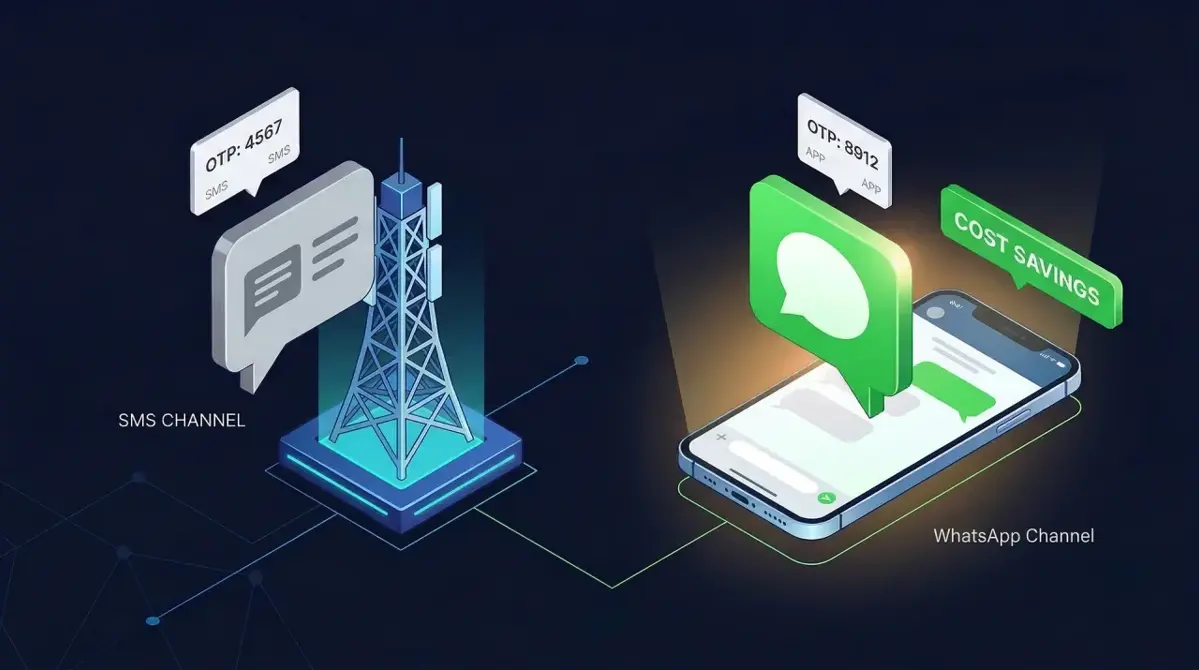
SMS OTP feels like a safe default — but once your user base grows, costs compound fast. WhatsApp OTP costs 70–90% less in most markets. Here's how they compare.
The Hidden Cost of “Free” SMS Authentication
SMS OTP feels like a safe default. Every phone can receive a text message, every developer knows how to integrate Twilio, and the first few thousand messages are cheap. But once your user base grows, SMS costs compound fast — and they can spike unpredictably if your OTP endpoint is targeted by fraud.
WhatsApp OTP is increasingly being used as a drop-in alternative. It delivers one-time passwords through WhatsApp instead of SMS, and in most markets, it costs 70–90% less per message. But is it the right choice for your app? Let’s compare them directly.
What Is WhatsApp OTP?
WhatsApp OTP uses the Meta (WhatsApp) Business Platform to send authentication messages — one-time passwords, verification codes, login confirmations — directly to a user’s WhatsApp app. The message appears in the user’s WhatsApp conversation with your business, usually with a button to copy or auto-fill the code.
From a user’s perspective, it looks and feels like receiving any other WhatsApp message. From a developer’s perspective, you call an API (either Meta’s Cloud API directly, or through a Business Solution Provider like Twilio or MessageBird) and pass the phone number. The user receives the message in their WhatsApp app.
There’s one important constraint: the user must have WhatsApp installed. In most markets, that’s the overwhelming majority of smartphone users — WhatsApp has 2 billion+ active users globally. But for the minority who don’t, you’ll need an SMS fallback.
Head-to-Head Comparison
| Factor | SMS OTP | WhatsApp OTP |
|---|---|---|
| Cost | $0.01–$0.51 per message depending on country | $0.001–$0.055 per message — 50–99% cheaper |
| Reach | Any mobile phone globally | Requires WhatsApp (~2B users; ~5–10% need fallback in high-WhatsApp markets, far more in the US, Japan, Korea) |
| Deliverability | Variable — carrier filtering, SIM issues, number portability gaps | Generally more reliable; delivered over internet, not carrier network |
| Security | Vulnerable to SIM swapping and SS7 attacks | End-to-end encrypted; less exposed to SS7/SIM swap |
| Fraud exposure | High — SMS pumping (toll fraud) is a real and costly threat | Lower — WhatsApp operates on Meta's network, not carrier toll systems |
| User experience | Familiar, universal | More modern; code auto-fill supported; arrives in a familiar app |
| Latency | Usually under 30 seconds; can be slow in some markets | Usually near-instant over internet connection |
| Setup complexity | Simple — most SMS gateways are a few lines of code | More initial setup (Meta Business verification, WABA approval) |
| Regulatory compliance | Varies by country; some markets have A2P registration requirements | Subject to Meta's Messaging Policy; some regulated industries may need review |
The Cost Difference: Real Numbers
Cost is usually the primary driver for switching. Here’s a concrete comparison based on Twilio SMS pricing vs. Meta WhatsApp Business Platform authentication pricing (data: February 2026):
100,000 Monthly OTPs — Cost Comparison by Market
| Market | SMS Cost/mo | WhatsApp Cost/mo | Monthly Savings | Savings % |
|---|---|---|---|---|
| Global mix (average) | $8,750 | $1,130 | $7,620 | 87% |
| India | $1,700 | $140 | $1,560 | 92% |
| Brazil | $5,990 | $680 | $5,310 | 89% |
| United Kingdom | ~$5,240 | ~$2,200 | ~$3,040 | 58% |
| Germany | ~$11,200 | ~$5,500 | ~$5,700 | 51% |
| United States | $830 | $340 | $490 | 59% |
The savings are especially large in developing markets (Africa, Asia, Latin America), which is also where WhatsApp penetration is highest. An analysis of 219 countries found that 100% of countries see at least 44% savings when switching from SMS to WhatsApp, and 58% of countries see 90%+ savings.
At enterprise scale (1M monthly OTPs), the global-mix savings reach ~$76,000 per month — or over $914,000 per year.
Security: Is WhatsApp OTP More Secure Than SMS?
Yes, in several meaningful ways:
End-to-End Encryption
WhatsApp messages are end-to-end encrypted between Meta’s servers and the recipient’s device. SMS messages travel over carrier infrastructure without encryption and can be intercepted in transit.
No SS7 Vulnerability
SMS is vulnerable to SS7 (Signaling System No. 7) attacks, where attackers exploit weaknesses in the telecom signaling protocol to intercept or redirect messages. WhatsApp bypasses the SS7 network entirely — it operates over the internet.
Reduced SIM Swap Risk
SIM swapping — where an attacker convinces a carrier to move your phone number to a SIM they control — can compromise any SMS-based OTP. WhatsApp has its own registration layer (tied to the device, not just the SIM), which adds friction for SIM swap attackers, though it doesn’t eliminate the risk entirely if the attacker also gains WhatsApp access.
Lower Fraud Exposure
SMS pumping attacks (where bots abuse your OTP endpoint to generate fraudulent messages to premium-rate numbers) are a pure SMS phenomenon. WhatsApp operates on Meta’s network, which doesn’t have the same carrier toll-sharing mechanics. Switching to WhatsApp eliminates this entire category of fraud exposure. Read more about how SMS pumping attacks work and how to prevent them.
Important caveat: WhatsApp OTP, like SMS OTP, is still a knowledge factor (something the user receives). It doesn't protect against phishing, where an attacker tricks the user into entering their OTP code on a fake site. For phishing-resistant authentication, see passkeys and FIDO2.
When to Use SMS OTP
SMS OTP remains the right choice in some scenarios:
- Universal reach requirement. If your users skew older or are in markets with lower WhatsApp penetration, SMS may deliver to a larger portion of your user base.
- Low SMS volume. If you're sending fewer than ~10,000 OTPs per month, the absolute cost difference is modest and may not justify the additional setup.
- Regulatory requirements. Some regulated industries (banking, healthcare) have specific guidance about authentication channels. Confirm what's approved in your jurisdiction.
- Fallback for WhatsApp. Even if you primarily use WhatsApp OTP, you should maintain SMS as a fallback for users who don't have WhatsApp — around 5–10% in high-penetration markets like India or Brazil, but well over half in the US, Japan, or South Korea where other messengers dominate.
When to Use WhatsApp OTP
- High SMS volume. The savings become meaningful at 50K+ monthly OTPs. At 100K/month or more, the difference is substantial.
- Global or developing-market user base. WhatsApp penetration is near-universal in many parts of Asia, Africa, and Latin America — the same markets where SMS is most expensive.
- Fraud protection priority. If you've experienced or are worried about SMS pumping attacks, switching to WhatsApp removes that attack vector.
- Modern UX. WhatsApp OTP supports code auto-fill and arrives in a familiar, trusted app context. It tends to have better completion rates than SMS in high-WhatsApp markets.
The Best Setup: WhatsApp Primary, SMS Fallback
Most production apps that have made the switch don’t fully abandon SMS — they implement a WhatsApp-first, SMS-fallback approach:
- Try to deliver via WhatsApp first
- If the user doesn’t have WhatsApp, or the WhatsApp message fails to deliver, automatically fall back to SMS
- Track which channel was used and report on your channel mix over time
This captures most of the cost savings (WhatsApp typically handles 90–95% of sends in high-penetration markets) while maintaining universal reach through SMS fallback.
How to Implement WhatsApp OTP
There are two approaches:
Option 1: Direct Meta Cloud API
Build directly against Meta’s WhatsApp Business Cloud API. Requires setting up a Meta Business account, getting a WhatsApp Business Account (WABA) approved, and building the API integration yourself. More control, lower per-message cost at scale, but more setup work.
Option 2: Use an Auth Platform with Built-In WhatsApp OTP
Platforms like Authgear offer WhatsApp OTP with SMS fallback out of the box — no separate WABA setup required. Authgear routes messages through WhatsApp by default and automatically falls back to SMS, with built-in fraud protection for both channels. This is the fastest path if you want to capture the cost savings without building the routing logic yourself.
Key Takeaways
- WhatsApp OTP costs 50–99% less than SMS across virtually every market globally
- WhatsApp is more secure: end-to-end encrypted, no SS7 vulnerability, lower fraud exposure
- The main limitation is WhatsApp reach — maintain SMS as a fallback for non-WhatsApp users
- A WhatsApp-primary, SMS-fallback setup captures most savings while keeping universal coverage
- At 100K monthly OTPs on a global mix, switching to WhatsApp saves ~$7,600/month ($91,400/year)
Ready to cut your SMS OTP bill? Get a live demo to see Authgear route OTPs over WhatsApp with automatic SMS fallback, or estimate your savings with the SMS cost calculator.
Related reading: How much does 2FA cost?, SMS OTP vulnerabilities and alternatives, and SMS pumping attacks.