
How Much Does Two-Factor Authentication Cost? A 2026 Pricing Guide
2FA isn't a single price — SMS OTP, WhatsApp OTP, TOTP, and passkeys have very different cost structures. Here's what each method actually costs at every scale.
The Real Cost of Two-Factor Authentication
Two-factor authentication (2FA) is table stakes for modern apps. But “2FA” isn’t a single product with a single price — it’s a category that spans methods with very different cost structures. SMS OTP, WhatsApp OTP, authenticator apps (TOTP), hardware keys, and passkeys all provide a second factor, but their total cost of ownership varies enormously.
This guide breaks down what each method actually costs, including per-message fees, platform licensing, and engineering overhead — so you can make an informed decision for your specific scale and user base.
The Four Main 2FA Methods and Their Cost Structures
1. SMS OTP — Pay Per Message
The most common 2FA method. Your app sends a one-time password to the user’s phone number via SMS every time they log in (or perform a sensitive action). You pay your SMS gateway provider per message sent.
Cost structure: Variable, per-message, ongoing. Costs scale directly with monthly active users and authentication frequency.
SMS pricing varies significantly by country. Here are representative per-message rates via Twilio (as of early 2026):
| Country | SMS Cost per OTP (Twilio) |
|---|---|
| United States | $0.0083 |
| United Kingdom | $0.0524 |
| Germany | $0.1120 |
| India | $0.0170 |
| Brazil | $0.0599 |
| Nigeria | $0.0920 |
| Egypt | $0.3959 |
| Global average | ~$0.0875 |
For a live estimate across your own countries, providers, and volume, use the SMS cost calculator.
Hidden costs to factor in:
- SMS fraud (pumping attacks can generate surprise bills — see our guide on SMS pumping attacks)
- Failed deliveries you still pay for in some configurations
- A2P (Application-to-Person) registration fees in some markets (US, India, others)
- Engineering time to build rate limiting, fraud detection, and fallback logic
2. WhatsApp OTP — Cheaper Per Message, Similar Model
WhatsApp authentication messages use the Meta Business Platform and are priced as “authentication conversations.” You still pay per message, but the rates are dramatically lower than SMS in most markets.
Cost structure: Variable, per-message (slightly higher minimum setup overhead, but lower ongoing cost).
| Country | WhatsApp Cost per OTP | vs. SMS |
|---|---|---|
| United States | $0.0034 | –59% |
| United Kingdom | $0.0220 | –58% |
| Germany | $0.0550 | –51% |
| India | $0.0014 | –92% |
| Brazil | $0.0068 | –89% |
| Nigeria | $0.0067 | –93% |
| Egypt | $0.0036 | –99% |
| Global average | ~$0.0113 | –87% |
Limitation: Users need WhatsApp installed. Typically 5–10% of users in WhatsApp-dominant markets won’t have it. A WhatsApp-primary, SMS-fallback approach captures most savings while maintaining full reach.
3. TOTP (Authenticator Apps) — Near Zero Marginal Cost
Time-based One-Time Passwords (TOTP) — used by Google Authenticator, Authy, 1Password, and others — generate codes on the user’s device using a shared secret. No messages are sent. No per-use cost.
Cost structure: Engineering time to implement (typically a few hours using a library like speakeasy for Node.js or pyotp for Python). Near-zero ongoing cost. Backup code storage adds minor database overhead.
Tradeoffs:
- Users must install and manage an authenticator app (higher friction, lower adoption for consumer apps)
- Account recovery when users lose their device requires careful design
- Not phishing-resistant — attackers can still harvest codes in real-time phishing attacks
- For best practices, see our guide on 5 common TOTP mistakes
Best for: B2B SaaS, developer tools, admin panels — contexts where users are technically sophisticated and motivated to use an authenticator app. Less suitable for consumer apps where convenience matters more than security depth.
4. Passkeys — Free to Send, Investment to Implement
Passkeys replace passwords and OTPs entirely using public-key cryptography. The user authenticates with Face ID, Touch ID, or a device PIN. No message is sent, no code is typed. The authentication is phishing-resistant by design.
Cost structure: No per-use cost. Engineering investment to implement WebAuthn/FIDO2 (moderate complexity — typically 1–3 weeks for a full implementation). Optional auth platform to reduce that engineering time.
Over time, passkeys are the lowest-cost 2FA method at scale: the marginal cost per authentication is effectively zero. The more returning users you have, the more you save versus SMS OTP. For a detailed implementation guide, see our passkeys guide.
Total Monthly Cost at Different Scales
Here’s how the costs add up at different monthly OTP volumes for a global user mix (average across 219 countries, data February 2026):
| Monthly OTPs | SMS Only | WhatsApp + SMS Fallback | TOTP (authenticator app) | Passkeys |
|---|---|---|---|---|
| 10,000 | $875 | ~$113 | ~$0 | ~$0 |
| 100,000 | $8,750 | ~$1,130 | ~$0 | ~$0 |
| 1,000,000 | $87,500 | ~$11,300 | ~$0 | ~$0 |
Note: WhatsApp + SMS Fallback assumes ~90% WhatsApp delivery, ~10% SMS fallback. TOTP and passkey costs shown are per-message costs only — implementation costs apply but are one-time.
Auth Platform Licensing: What Does It Actually Cost?
Beyond per-message costs, you may pay for an authentication platform that provides 2FA infrastructure (user management, session handling, MFA enrollment flows, passkey support, etc.). The main options:
Build In-House
Engineering cost varies wildly. A basic SMS OTP implementation takes days. A production-grade auth system with TOTP, passkeys, session management, fraud protection, and account recovery takes months. Ongoing maintenance is an indefinite commitment.
Duo Security (Cisco)
Duo is one of the most searched platforms in this category. Its free tier covers up to 10 users. The Essentials plan starts at $3/user/month; the Business plan is $6/user/month; Enterprise pricing is custom. For a team of 500 users, that’s $1,500–$3,000/month just for the MFA platform — before any SMS costs. Duo is strong for workforce/employee 2FA but is less suited to consumer-facing authentication at scale.
Auth0 / Okta
Popular enterprise auth platforms. Auth0’s free tier covers up to 25,000 MAUs; paid plans start around $23/month and scale with MAU count. Enterprise plans can run into thousands per month. Okta’s pricing is user-seat-based, similar to Duo. Both include MFA features and are known for a broad enterprise feature set — and a price tag that reflects it.
Firebase Authentication
Free for most features, including phone authentication (SMS OTP) which has a free tier (10K verifications/month for some regions) then usage-based pricing. Limited to Google’s ecosystem; less control over customization.
Authgear
Authentication platform with built-in WhatsApp OTP, SMS OTP, TOTP, passkeys, and SSO. Designed to reduce OTP costs, not just manage them. Includes SMS pumping protection, biometric login, and SSO across apps. Pricing is usage-based with a generous free tier. The combination of platform licensing + lower per-message cost (WhatsApp vs. SMS) often results in a lower total cost than Auth0 or Okta + a separate SMS gateway. See the SMS cost reduction calculator for a personalized estimate.
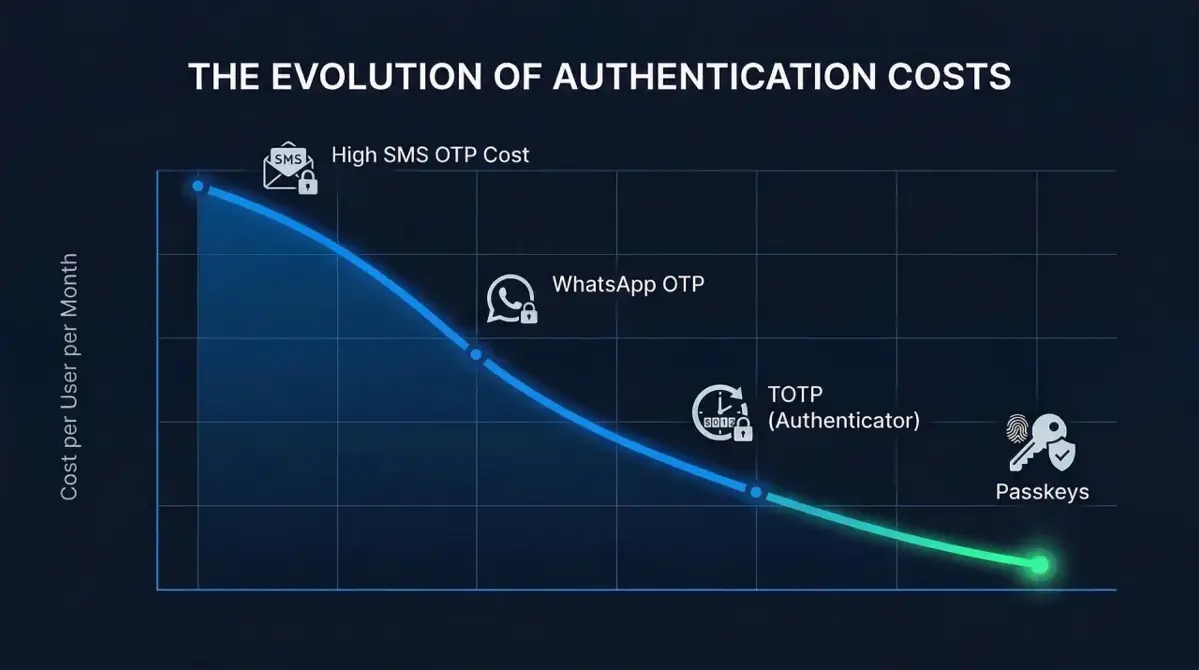
The Cost Curve: Why 2FA Gets Cheaper Over Time (If You Plan It Right)
Here’s the key insight that most 2FA cost discussions miss: your cost structure should improve as your user base matures.
The first time a user authenticates (signup), they almost always need an OTP sent to them — there’s no other way to verify the phone number. But returning users don’t need a fresh OTP every session if you’ve set up passkeys or biometric login.
A mature auth setup looks like this:
- New user signup: WhatsApp OTP (or SMS fallback) to verify phone number — one-time cost
- First login after signup: Prompt user to set up passkey or biometric login
- Returning user login (month 2+): Passkey or biometric — zero OTP cost
- Account recovery / new device: WhatsApp OTP as fallback — occasional cost
With this approach, your OTP volume grows much slower than your user base. An enterprise with 1M MAUs might only send 50K–100K OTPs per month (covering new signups, new devices, and recovery flows) rather than 1M OTPs per month for every login. That’s a 90%+ reduction in message volume — and therefore cost.
What Should You Budget for 2FA?
A rough framework based on monthly OTP volume and market:
| Stage | Monthly OTPs | Recommended Approach | Estimated Monthly Cost |
|---|---|---|---|
| Early / MVP | <10K | SMS OTP (any gateway) | $50–$500 depending on market |
| Growth | 10K–100K | WhatsApp + SMS fallback | $150–$1,200 (vs. $1K–$9K SMS-only) |
| Scale | 100K–1M | WhatsApp + SMS fallback + passkeys for returning users | $1K–$12K (vs. $9K–$88K SMS-only) |
| Enterprise | 1M+ | Passkeys primary + WhatsApp OTP for new users only | Platform fee + minimal OTP cost |
Key Takeaways
- SMS OTP is the most expensive 2FA method at scale — costs compound with every login
- WhatsApp OTP cuts per-message costs by 50–99% across virtually all markets
- TOTP (authenticator apps) and passkeys have near-zero marginal cost but higher implementation effort
- The smartest long-term approach: WhatsApp OTP for new users + passkeys for returning users = cost curve that trends toward zero
- Auth platform licensing (Auth0, Authgear, Firebase) adds monthly fees but reduces engineering overhead — factor in both sides of the equation
If you want a concrete estimate for your specific user volume and market mix, the Authgear SMS cost calculator can show you potential savings by market.
Want to see it live? Get a demo of Authgear’s WhatsApp-first OTP with SMS fallback and passkey support.
Related reading: SMS OTP vs WhatsApp OTP, SMS OTP vulnerabilities and alternatives, and SMS pumping attacks.